The High Priestess (II): Tarot Card Meaning
The second trump. Not a card about other people’s secrets — a card about the thing you would bet money on and have never once said.
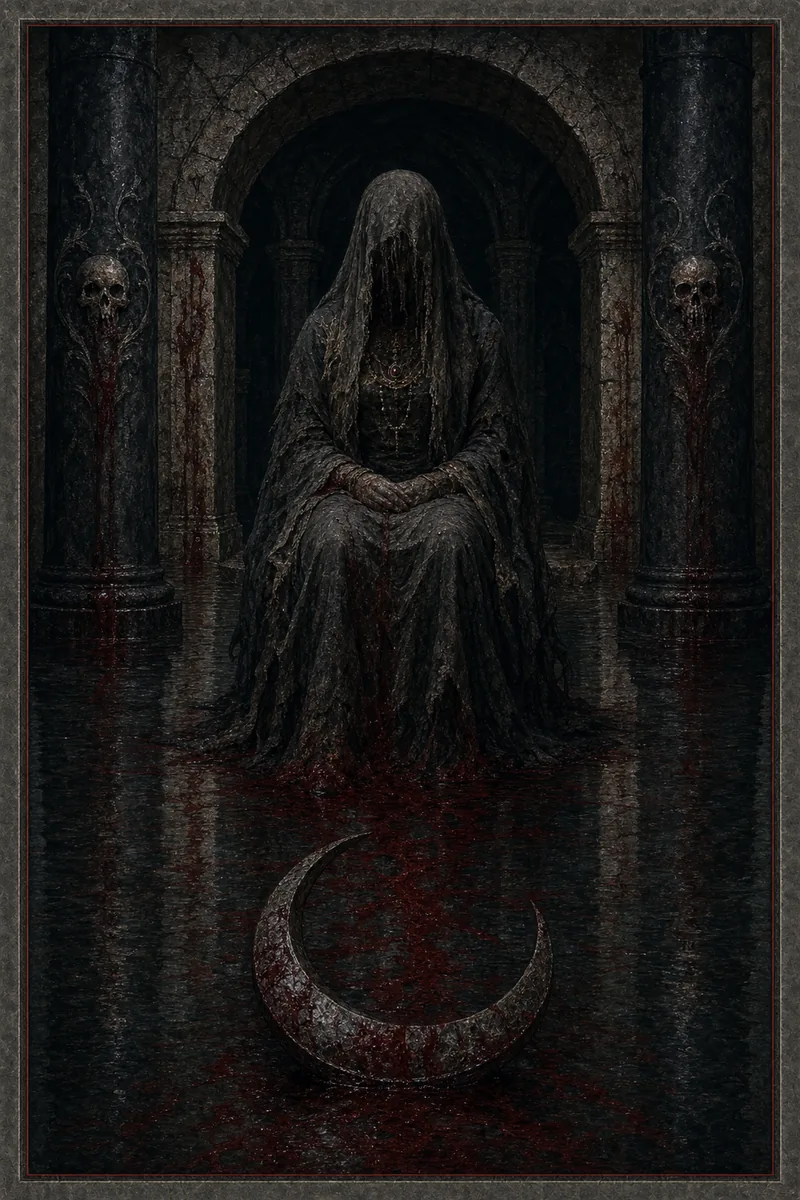
- Numeral
- II
- Sign
- Luna
- Element
- WaterWater reads the room before anyone speaks, and remembers what it read.
- Stage
- Beginning
- Charge
- Neutral
- Keywords
- secrets · intuition · depth
Upright
Something you already know and have not said out loud.
There is a difference between what you would write on a survey and what you would put money on. This card lives in that gap. Upright, it says the second number exists and you have already worked it out.
People generally treat that as being unsure. It is not: an unsure person has no second number. What is actually happening is that the second number commits you to something, and the survey answer does not.
The card does not ask for a confession. It asks you to notice that you were never undecided, and to stop spending effort on gathering more information you will not use. That expenditure can go on for a year, and it looks diligent from the outside.
Reversed
The voice inside that you keep stepping past.
Reversed, the charge does not change — this trump is neutral both ways up, and a reading that makes the reversal darker is contradicting the card directly. What changes is the volume of everything else.
The usual mechanism is not refusal, it is noise. Something plays the moment the car door shuts. A screen is on while the kettle boils. None of it is avoidance in any way you could be accused of, and all of it works: the unwelcome thought never gets far enough along to finish.
Which is why the verdict stays undecided, and that is a report rather than a hedge. Nothing outside you is holding the answer back. It is waiting on somebody to say it, and this trump has never been the one who says it.
Yes or no
- Upright
- Not yet clear
- Reversed
- Not yet clear
Undecided, both ways up, and that is the honest reading rather than a hedge. What settles this question is not a circumstance that could turn either way but a decision already taken and not yet admitted to.
Where the card comes from
What the older card shows, and what ours takes away
In the Rider-Waite the Priestess holds a scroll marked TORA, half hidden in the folds of her robe. Knowledge, present and deliberately not fully shown. It is the detail almost every description of the card leans on.
Ours has no scroll. Her hands are empty, and the only object in the frame is a crescent lying flat in the flooded floor in front of her. Nothing is being withheld from you, because there is no document to withhold. What is being kept is not the kind of thing that can be handed over.
She has no face either. Not shadowed, not turned away — the cloth falls straight from her head to her lap and there is nothing behind it to read. You will not get a tell out of this one.
The pillars, and who is sitting on them
The two pillars are traditionally lettered B and J, for Boaz and Jachin, and the reader is meant to pass between them. Ours are capped with skulls. The people on top of these pillars have already been through.
she is the secret Church, the House which is of God and man
Luna, Gimel, and the Silver Star
The attribution is Luna, which is the astrologers’ name for the moon as a body — kept in Latin here precisely because The Moon is also a card, and "The Moon" as a label on card two would read as an error. Luna has no light of its own; it reflects, and how much shows depends on where it is standing.
Its letter is Gimel, the camel: an animal that carries its supply inside itself and crosses country that provides nothing. The Golden Dawn title is Priestess of the Silver Star, and silver rather than gold is the whole point — a metal that reflects instead of one that burns.
Two
Two is the first number that makes comparison possible. One can only exist; two can differ. That is why this trump sits immediately after The Magician: one picks and acts, the other holds and weighs, and a deck with only the first would be unbearable.
In a reading
As a Daily Card this rarely forecasts an event. It marks a day that will reward listening and punish announcing.
In a three-card reading it turns up most often in the present position, where it describes something you are holding right now rather than something coming. Ahead of you it is at its plainest: the unsaid thing will not resolve on its own.
Common questions
Is The High Priestess about intuition or about wishful thinking?
Both feel identical, so the card offers a test rather than a definition: an intuition gets MORE specific when you interrogate it, and wishful thinking gets vaguer. Ask it a second question and see which way it moves.
What do the two pillars mean?
In the older card they are Boaz and Jachin, the two columns of the temple, and the reader passes between them into what is behind the veil. Ours are capped with skulls, which makes the same claim less politely.
Can this card mean a real person?
Sometimes, and when it does it is usually somebody who knows the situation better than they have let on — not out of malice, but because they were never asked a direct question.
Why is a reversed High Priestess not the darker version?
Because the trump’s charge is neutral, and neutral does not invert. A reading that makes the reversal sinister is contradicting the card’s own data, which this page prints directly above the interpretation.