The Hierophant (V): Tarot Card Meaning
The fifth trump. Not a card about religion — a card about the difference between knowing a thing and being permitted to say it.
- Numeral
- V
- Sign
- Taurus
- Element
- EarthEarth wants the thing to still be standing next year.
- Mode
- FixedKeeps the position long after the argument for it has moved on.
- Stage
- Beginning
- Charge
- Neutral
- Keywords
- tradition · teaching · vows
Refuses to be hurried, and keeps whatever it has decided to keep.
Upright
A lesson handed down that still earns its place.
Most crafts contain some knowledge that is freely available and some that you are only handed once somebody vouches for you. The second kind is what this trump is about, and upright it says a door of that sort has opened.
That arrangement is not a conspiracy and it is not entirely fair either. It exists because certain things cannot safely be given to a stranger, and the cost is that access depends on being recognised — which is a slow, personal and often unjust filter.
The charge is neutral and stays neutral. Being admitted to something is not the same as the thing being good, and the card declines to tell you which you have. It only reports that the transmission is happening.
Reversed
A rule that has outlived its reason.
Reversed, the charge is unchanged — neutral both ways — and what inverts is the direction of the authority. The office is now speaking on subjects the office was never given.
This is common and it is rarely deliberate. Somebody earns standing in one narrow area and is then asked, deferentially, about everything else, and answering is the polite thing to do. Nobody in the room has an incentive to point out where the mandate ran out.
So the verdict turns to no. Not because the source is dishonest, but because you are about to take an answer on a subject the source is not actually standing on, and the confidence you are reading came from somewhere else.
Yes or no
- Upright
- Yes
- Reversed
- No
Upright, yes, on one condition: take the method and leave the standing. Reversed it turns to no — the confidence in front of you was earned somewhere other than the subject you are asking about.
Where the card comes from
Taurus, and the slowest thing in the deck
The sign is Taurus: earth, and fixed. Fixed signs hold the middle of a season rather than opening or closing it, and fixed earth is the slowest of the twelve combinations to change its mind about anything.
That is not an insult and it is not an accident. An institution is asked for exactly one thing above all others: be the same next year. A body that reconsidered its position monthly could transmit nothing, because there would be nothing stable enough to transmit.
Vav, and a title that keeps the word Magus
The letter is Vav, which means a nail or a peg, and which in Hebrew grammar also serves as the word "and". It has no content of its own; its entire job is to join two things into one object. A joint is not a source, and a teacher who forgets that begins to believe the material originated with them.
The Golden Dawn title is Magus of the Eternal Gods. It is worth noticing that he is still a magus, like the first trump. The difference is whose capability is being pointed: card one aims its own, and this one aims what it was handed.
The height of the pulpit
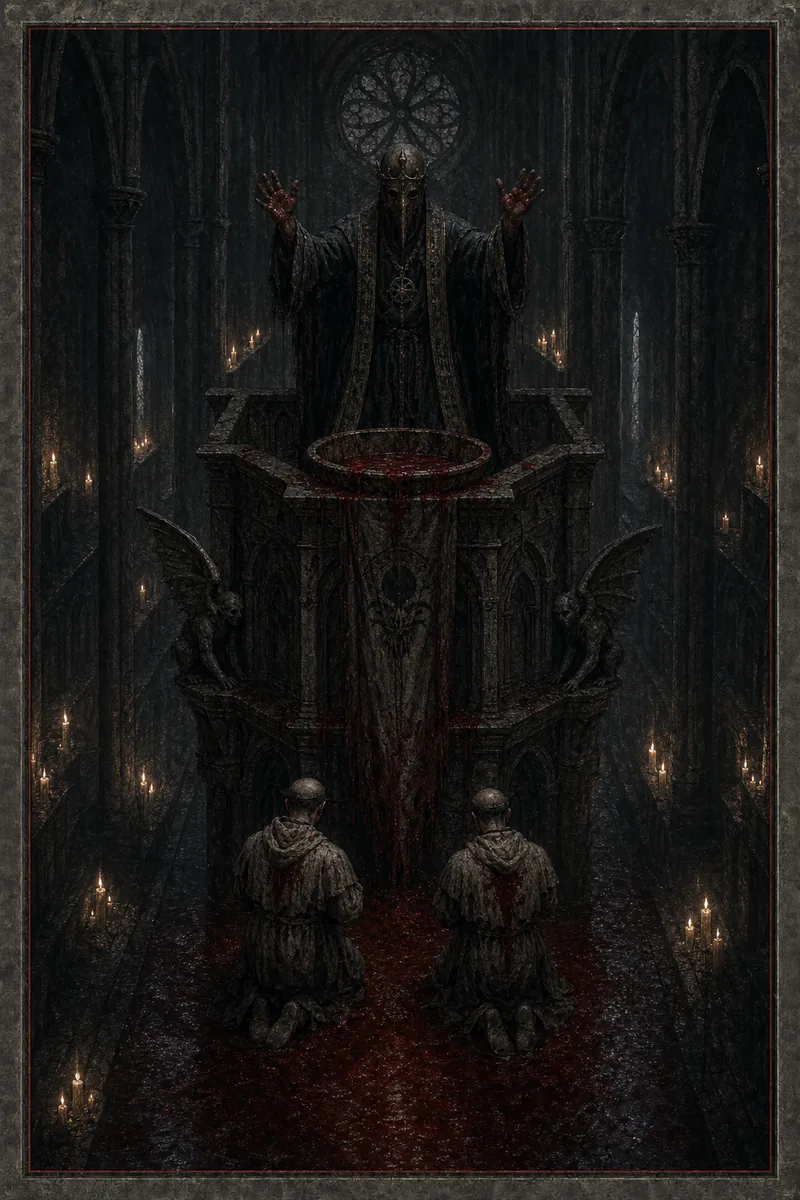
The familiar card has him seated, one hand raised in benediction. Ours has him standing on a tall pulpit with both hands up, and the two kneeling figures are a long way below him.
The distance is the reading. Instruction travels from the pulpit to the floor intact. What does not make the trip is a question going the other way, and no part of the architecture was built for one.
The floor is under water and the water is dark. The candles along the walls are all still lit and nobody has put them out. Whatever has happened in this building, the building is still running.
Five
Five is the first disruptive number: four has just closed a room, and five is what does not fit inside it. In most schemes five is the number of upheaval. Filing the institution here is an admission that institutions appear precisely because something did not fit.
In a reading
As a Daily Card it usually names one person who has already been through what you are in the middle of, and whom you have not asked.
In a three-card reading, behind you it is almost always family or school — something installed before you had a vote. Ahead of you it offers an existing method, and offering is not instructing.
Common questions
Who are the two kneeling figures?
In the older card they are ministers being instructed, which makes the picture a scene of transmission rather than of worship. Ours puts them further away and lower down, which sharpens the same point: this is a one-directional channel.
Is this card about a mentor?
Often, and usefully so. A mentor is the small version of the institution: somebody who hands you a method they did not invent, along with the standing to use it. The reversal is the same person answering outside their subject.
Does The Hierophant mean marriage?
It can, in the narrow sense that a marriage is a private arrangement given a public form by an institution. That framing is what the card contributes; whether the relationship is a good one is a different card entirely.
The Hierophant or The Emperor for a question about rules?
The Emperor sets a rule and can change it. The Hierophant transmits one that predates them and that they could not change alone even if they wanted to.