The Emperor (IV): Tarot Card Meaning
The fourth trump. Not a card about power — a card about the difference between a decision you keep making and one you made once.
- Numeral
- IV
- Sign
- Aries
- Element
- FireFire moves first and asks what it cost afterwards.
- Mode
- CardinalStarts the thing. Whether anyone was ready is a question it does not wait for.
- Stage
- Beginning
- Charge
- Neutral
- Keywords
- order · authority · structure
Begins before the plan is finished, and is usually why anything began.
Upright
Structure that makes your footing calmer.
A decision is something you make. A policy is something you made. The whole of this trump is in that tense, and upright it says one of your recurring costs has quietly become the second kind.
The saving is larger than it looks. A question that is settled once stops consuming attention every time it comes round, and most people are not tired from the hard choices but from the same easy one arriving forty times.
Its charge is neutral and stays neutral in both orientations. The card does not take a side, because the identical arrangement can shelter a thing or trap it, and which one it is depends on the contents rather than on the walls.
Reversed
Control mistaken for strength.
Reversed, the charge is still neutral — reading this as the sinister version contradicts the data printed above it. What inverts is what is being mistaken for strength: a grip tightening is not usually a sign of power, it is a sign of expecting to lose something.
There is an external test. A policy that is doing real work carries its own reason and survives the absence of whoever set it. An arrangement that is only control evaporates the moment its author is out of earshot, and everybody involved can already tell you which one they are living under.
The verdict turns to no, and rarely because the plan is bad. It is because the thing you are about to add is another layer of procedure to a situation that is short of trust, and procedure has never once produced trust.
Yes or no
- Upright
- Yes
- Reversed
- No
Upright, yes — with this card’s characteristic condition: yes if you will settle it once rather than agree to it repeatedly. Reversed it turns to no, because what is short here is trust, and no arrangement produces that.
Where the card comes from
Sun of the Morning
The Golden Dawn title is Sun of the Morning, Chief among the Mighty. The first half is the interesting one, and it is easy to read past: morning, not noon. This is not the card of an established power at its height. It is the card of the hour a thing begins to be governed.
That matches its sign exactly. Aries is cardinal — the cardinal signs open the seasons — so the founding rather than the maintaining is the part this trump owns. Whoever is merely keeping an old arrangement alive is on a different card.
Fire under a neutral charge, and a window
The element is fire, which is why the card reads hard even where it is helping. Fire asks nothing. What stops it consuming everything is not any gentleness of its own but the shape somebody built around it, and this trump is that shape rather than the flame.
Its letter is Heh, a window: a hole made deliberately in a wall, where what makes it a window rather than damage is that the wall is still standing. It is the whole argument of the card compressed into one noun.
Spikes, ram skulls, and a flight of steps
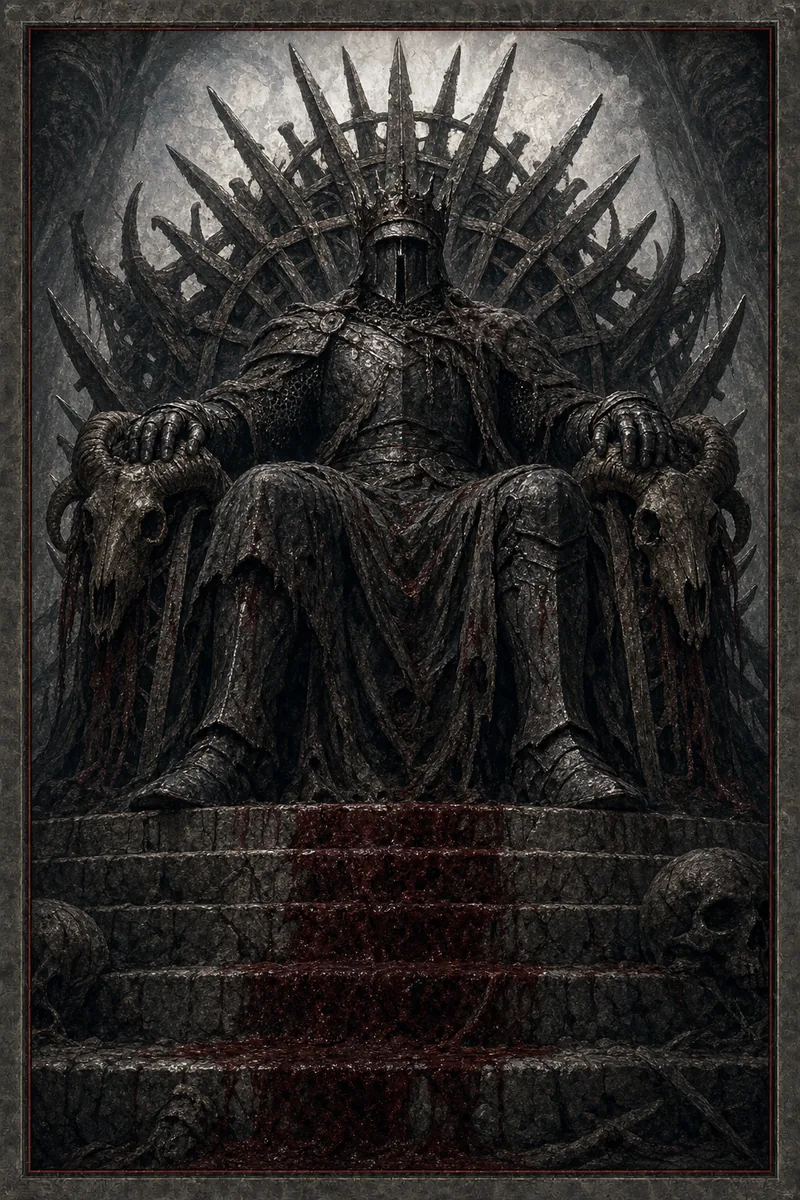
The back of our throne is a crown of iron spikes facing outward. Head on, it reads as rays. From the side it is a barricade. Both readings are correct and the painting is not choosing between them.
A ram skull sits on each arm rest. The ram is the animal of Aries, and here nothing is left of it but the bone. A card about limits has mounted the remains of an unlimited impulse exactly where the hands come to rest.
And the throne is at the top of a flight of steps with blood running down them. Elevation is part of the office. Whatever is decided up there is received first by whoever is standing lower, and the card is not pretending otherwise.
Four
Four is the smallest number of corners that encloses anything. Three can stand on its own with no walls at all; four shuts. Every later trump needs somewhere for its events to happen, and this is where the deck builds it.
In a reading
As a Daily Card it usually names one thing to settle today so that it stops being renegotiated: a boundary, a time, a number both sides have agreed.
In a three-card reading, behind you it often means an arrangement you inherited and have never audited. Ahead of you it is an offer of structure, and an offer is not an instruction.
Common questions
What do the ram skulls mean?
The ram is the animal of Aries, this card’s sign. Rendering it as bone puts the impulse in the past tense: the force that founded the arrangement is finished, and what is left is the arrangement.
Does The Emperor mean a man?
Occasionally, and it is seldom the most useful reading. More often it points at the structure itself — a rule, a schedule, a limit — and structures have no gender.
What if the authority in the question is one I did not choose?
Then the card is describing the walls rather than endorsing them. Its charge is neutral for exactly this reason: it reports that something is being held in a shape, and leaves the question of whose shape to you.
The Emperor or Justice for a question about fairness?
The Emperor is about whether a rule exists and holds. Justice is about whether the rule is the right one, which is a different question and a harder card.