The Empress (III): Tarot Card Meaning
The third trump. Not a card about plenty — a card about the difference between a thing that grows and a thing that is assembled.
- Numeral
- III
- Sign
- Venus
- Element
- EarthEarth wants the thing to still be standing next year.
- Stage
- Beginning
- Charge
- Light
- Keywords
- abundance · nurture · body
Upright
Something growing because it is genuinely being fed.
Some things are built and some things are grown, and the two obey different rules. A built thing can be finished early by working harder. A grown thing cannot, at any price, and this trump is only ever about the second kind.
That is why it is a difficult card to receive when you are impatient. It does not respond to effort in the way the rest of your week does. It responds to being returned to, which is a much smaller demand made a much larger number of times.
Upright it is usually recognition rather than news. Something has been getting that treatment for long enough that it has started to show from outside, and the person most surprised by it is generally the one who did it.
Reversed
Care given well past your own limit.
Reversed, the rule holds and the accounting breaks. Care given past your own limit is not a better grade of care; it moves the shortage somewhere else, usually somewhere nobody is auditing.
It rarely looks like a crisis. It looks like a person everybody can depend on and nobody can ask anything of, because the asking has had nowhere to go in their calendar for a long time.
So the verdict inverts to no. Not because the thing you are tending is unworthy — the card never argues that — but because one more commitment would be drawn from an account that is already at zero.
Yes or no
- Upright
- Yes
- Reversed
- No
Upright, yes, on an unglamorous condition: yes if you can return to it for as long as it takes, which is longer than you think. Reversed it turns to no, because the next commitment comes out of an account already at zero.
Where the card comes from
Still a beginning, and that is the surprise
This deck files each trump under one of three stages, and The Empress is filed under `beginning` alongside The Fool and The Magician. That reads wrong at first: she is the heaviest figure in the opening set and the only one carrying something.
It is right, and it is the most useful thing the classification says about her. Everything on this card is still ahead of itself. Nothing has been tested, nothing has survived a winter, and the outcome is entirely contingent on somebody continuing to show up. A beginning is not a small thing; it is an unfinished one.
Venus, brought down to earth
The planet is Venus and the element is earth, and the pair explains the card better than any single word. Venus alone reads as beauty. Earth drags it somewhere far less romantic: soil admires nothing, holds what it is given, and charges in time rather than in effort.
Her letter is Daleth, a door — the place a thing enters the world, and also the only part of a house that is built to be shut. Both properties belong to this card and the second is the one people forget. The Golden Dawn title is Daughter of the Mighty Ones: not the powers themselves. Whoever makes a thing grow is seldom whoever decided it should.
A garden with nothing living in it
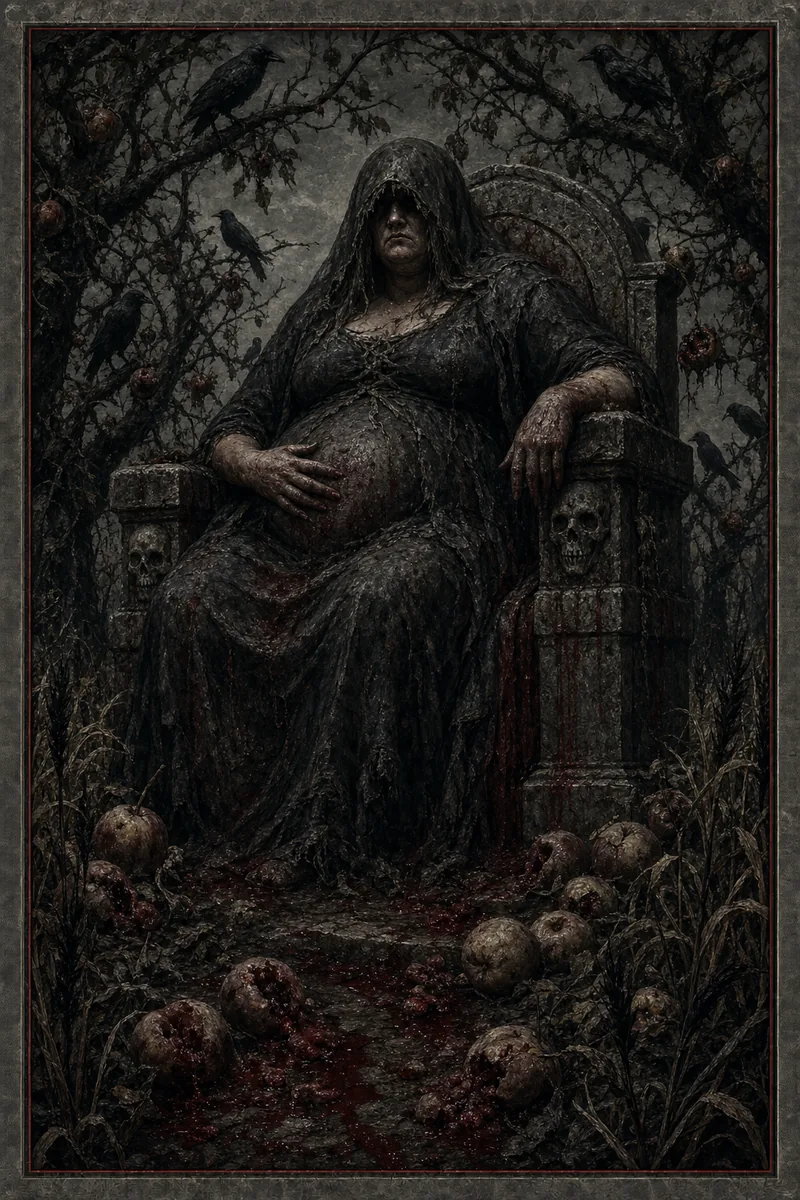
The familiar version of this card seats her in ripe wheat with a stream behind her. Ours seats her in dead thorn. Crows are in the branches and there are skulls in the ground.
That is not cynicism, it is a choice of month. The painting has put her in the part of the year where what is growing is still entirely dependent on the person tending it, and where nothing in the surroundings is helping. Harvest is a different card.
Her throne is stone and carved with skulls, and her hand rests on her belly. The card declines to separate what is arriving from what has already gone. It puts them on one seat.
Three
Three is the first number that can produce something: two can face each other, three can make. Two later trumps fold back here — The Hanged Man at twelve and The World at twenty-one — and both are about what happens once a thing has finished growing.
In a reading
As a Daily Card it usually points at one thing that needs a little today — not finishing, just attending to. This trump counts small repeated acts and is indifferent to large single ones.
In a three-card reading, behind you it almost always indicates somebody who tended you rather than the other way round. Ahead of you it is a question about stamina, and answering it honestly is allowed.
Common questions
Does The Empress mean pregnancy?
It can, and it is not the default. The card is about anything that grows because it is continuously fed — a business, a craft, a friendship. Reading it as a literal pregnancy every time is how a tarot reader ends up wrong in public.
Why is our garden dead when the traditional card is a wheat field?
Because the painting picks a different month. Ripe wheat is a harvest, and harvest is the end of the story this card tells. Dead thorn puts the dependence back: nothing here survives without the person on the throne.
What does Venus actually contribute here?
Less than you would expect on its own. Paired with earth it stops being about beauty and becomes about attachment to a particular thing over a long period — which is a much better description of what the card asks for.
The Empress or The Hierophant for a question about family?
The Empress is what is being fed in a family right now. The Hierophant is what the family inherited and still repeats, whether or not it still works.