Death (XIII): Tarot Card Meaning
The thirteenth trump. It describes something that has already finished, and it is almost never about anybody dying.
- Numeral
- XIII
- Sign
- Scorpio
- Element
- WaterWater reads the room before anyone speaks, and remembers what it read.
- Mode
- FixedKeeps the position long after the argument for it has moved on.
- Stage
- Trial
- Charge
- Shadow
- Keywords
- ending · threshold · release
Goes to the bottom of a thing, and does not report back until it has.
Upright
An ending that frees you.
Before anything else: this card is almost never about a person dying. Any question about somebody’s health belongs with a doctor, and no arrangement of cards is entitled to an opinion about it.
What the trump actually measures is a gap. There is a date on which something stopped working, and a later date on which somebody said so out loud, and the distance between those two is where most of the damage lives. Upright, the card says the first date is behind you.
That gap is expensive in a specific way. Everything scheduled during it was planned around a thing that had already stopped, so the plans were sound and the premise was not — which is why the period afterwards so often reads as wasted rather than as unlucky.
Reversed
Holding on to something already finished.
Reversed, the charge becomes LIGHT: this trump is shadow upright and light inverted, and a reading that makes the reversal grimmer contradicts the strip printed above it. What it names is holding on to something already finished.
It seldom looks like denial. It looks like continuity — arrangements kept exactly as they were, out of decency rather than confusion. None of that is wrong, and all of it is a standing charge.
The verdict flips to yes, and the yes is not for the old thing. It is for the next one, which has been waiting because starting it would function as a statement about the first, and nobody wants to make that statement on a Tuesday.
Yes or no
- Upright
- No
- Reversed
- Yes
Upright, no: what you are asking about rests on something that has already stopped standing. Reversed it flips to yes — not to the old thing, but to the next one, deferred because beginning it would say the first is over.
Where the card comes from
The card with no name
In the Marseille decks the thirteenth trump carries a number and NO TITLE. Every other card in the sequence is captioned; this one is left blank, and the blank is deliberate rather than a printing accident.
The usual explanation is superstition, and the more interesting one is grammatical. A caption tells the reader what the picture is of. Withholding it on this card leaves the image to make the claim, which is the correct call for the one trump whose title people read as a prediction the moment they see it.
Ours is captioned, because a modern deck that left one card blank would read as a missing file rather than as reticence. What the older decks were protecting is protected here by the writing instead.
Scorpio, Nun, and a gate
The sign is Scorpio: water, and fixed. Fixed water does not flow anywhere — it is deep rather than moving, and of the twelve combinations it is the least susceptible to being talked round. This card does not negotiate because its sign does not.
Its letter is Nun, a fish: an animal that lives where the surface cannot see and surfaces without warning. The Golden Dawn title is Child of the Great Transformers, Lord of the Gate of Death — and the operative noun is gate. A gate is a place you pass through, not a place you stop.
A field that is already over
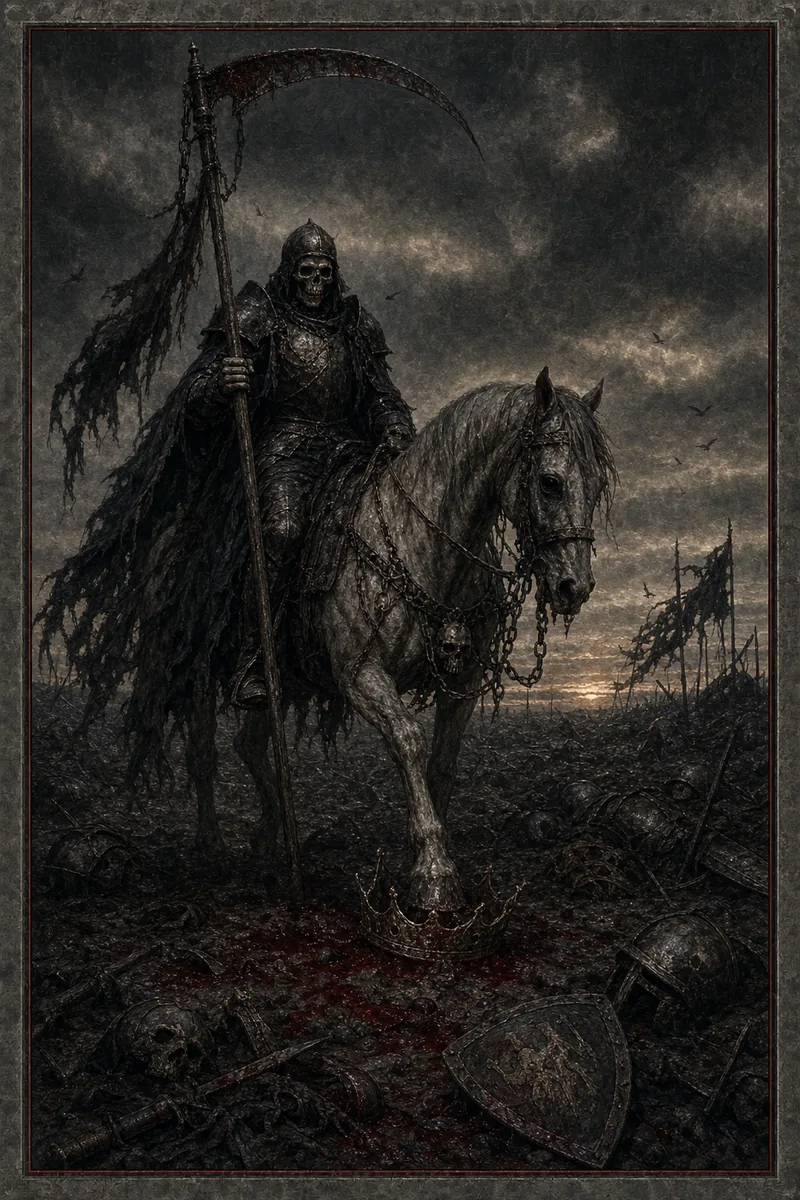
Our rider is skeletal, armoured, carrying a scythe, on a pale horse. So far the painting is doing what this card has done for six hundred years.
The field is where it departs. He is not attacking anybody. Everything on the ground was on the ground before he arrived — shields, skulls, mud, banners already torn and leaning. The battle finished and he came afterwards.
That single decision governs the whole reading. This figure is not a cause. He passes through and records, and the sun behind him is already low.
Thirteen, and its root
Thirteen folds to four, which is The Emperor. The pairing is uncomfortable and exact: the card that sets limits stands behind the card that closes something, because an ending is the one boundary nobody can renegotiate.
In a reading
As a Daily Card it usually points at one small thing that has been renewed without a reason for a while, and could be closed today.
In a three-card reading, behind you it is almost always right and often a relief. Ahead of you it is not a forecast of loss; it marks a closure that is waiting to be said rather than to happen.
Common questions
Does Death predict a death?
No, and this page will not read it that way. It describes something that has already finished and has not been acknowledged. Questions about anybody’s health belong with a doctor; a card is not qualified and neither are we.
Why do the oldest decks leave this card unnamed?
Superstition is the usual answer and it is probably part of it. The better reason is that a caption tells you what a picture is of, and this is the one trump whose caption gets read as a forecast the instant it is printed.
What if I have just lost somebody?
Then the card is not telling you anything you do not know. The useful reading in that situation is rarely about the ending at all — it is about what is still being run exactly as it was.
Death or The Hanged Man when I need to let something go?
The Hanged Man suspends a thing that could still resume. Death is for the one that has already finished; the only question left on it is whether anybody has said so.