The Tower (XVI): Tarot Card Meaning
The sixteenth trump. Not a card about random disaster — a card about a failure that finally happened quickly instead of taking another four years.
- Numeral
- XVI
- Sign
- Mars
- Element
- FireFire moves first and asks what it cost afterwards.
- Stage
- Reckoning
- Charge
- Shadow
- Keywords
- collapse · lightning · truth
Upright
A collapse that needed to happen.
The same failure can arrive at two speeds, and the difference between them is most of what happens to the people involved. A company can shut in a month or bleed for five years. A relationship can end in a conversation or in a decade of managed disappointment.
The slow version is worse and it is what everybody chooses, because each individual month of it is survivable and the fast version is not. Nobody ever opts for the tower. It has to be done to them.
Upright, the card says the fast version has arrived, and that is the whole of its mercy. It answers no — refusing anything built on the part that just came down — and the refusal is narrow. Build. Not there.
Reversed
A warning let past again and again.
Reversed, the charge becomes LIGHT, because this trump is shadow upright. What it names is a warning let past again and again, which means the collapse has not happened and the slow version is currently running.
It does not present as neglect. It presents as competence: an emergency repair every few months, an explanation that is always the same one, one person who quietly absorbs the shortfall each time and has stopped mentioning it.
So the verdict flips to yes — not to demolishing anything yourself, but to looking properly now, while the timing still belongs to you rather than to the weather.
Yes or no
- Upright
- No
- Reversed
- Yes
Upright, no, and it refuses only what would be built on the part that just failed. Reversed it flips to yes — to looking now, while the timetable is still yours and not something else’s.
Where the card comes from
Lord of the Hosts of the Mighty
The Golden Dawn title is Lord of the Hosts of the Mighty, and `hosts` there means armies. Not one force: many, arriving together. That is a better description of how things actually fall over than a single bolt is.
Structures almost never fail from one cause. They fail when three tolerable problems coincide, which is why the post-mortem always finds several and why nobody can be blamed cleanly.
Mars, and a mouth
The planet is Mars and the element is fire — the only card in this deck given both with no zodiac sign in between. Mars postpones nothing; what it does is accelerate what was going to happen anyway, which is exactly the reading above.
The letter is Peh, the mouth. For a card about masonry that is a surprise and it is the most accurate detail in the attribution: what most often brings a structure down is not weather but somebody finally saying the thing everyone already knew.
No crown
In the familiar card the first thing to go is the crown on the tower’s top, blown clear by the strike. The signal is unmistakable: what is falling is power, or pride, or something that had it coming.
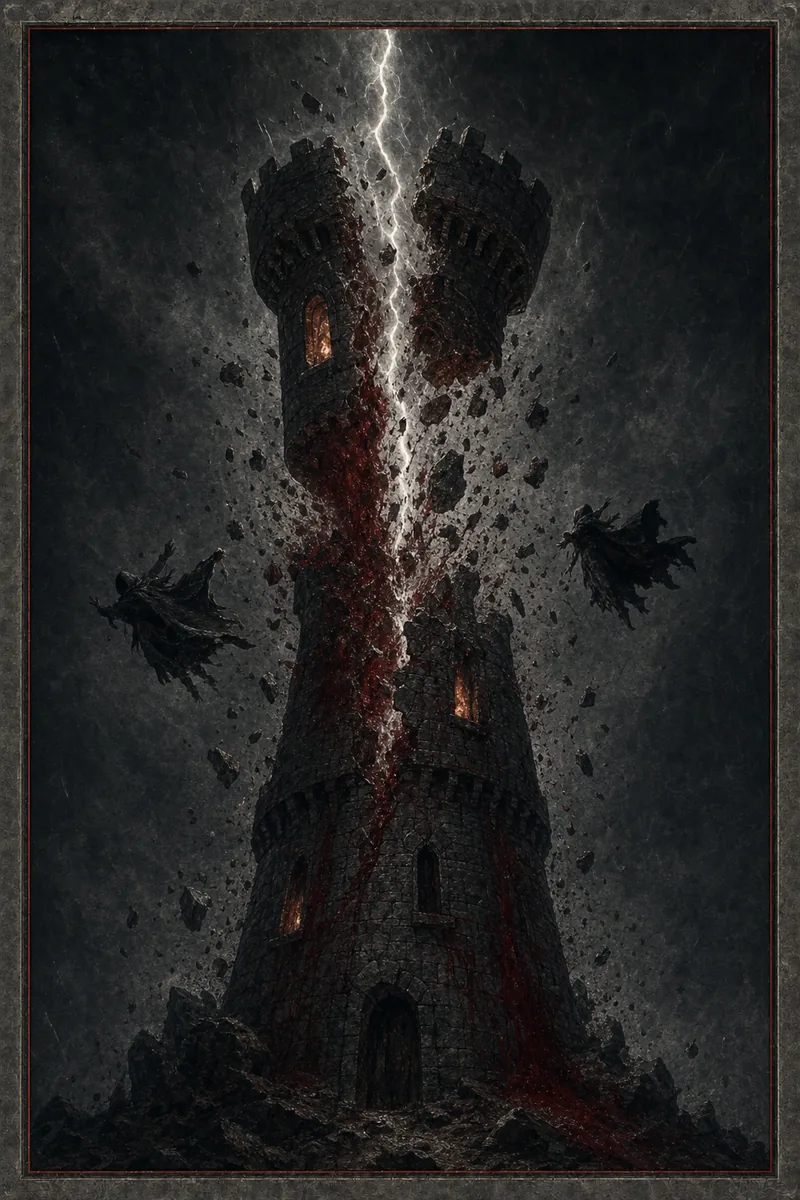
Ours has no crown. The tower is split from top to bottom by one strike, the stone is bursting outward, and two figures fall on either side. There is fire in the window slits, which means somebody lived there.
Removing the crown removes the moral. Nothing here is falling because it deserved to. It is a building with people in it, which is the reading that turns out to be right far more often.
it is the ruin of the House of Life, when evil has prevailed therein
Sixteen, and its root
Sixteen folds to seven, which is The Chariot. The card about something travelling fast and still steerable stands directly behind this one, and the distance between them answers the question of what happens when nobody holds the reins for long enough.
In a reading
As a Daily Card it seldom means a ruined day. More often it marks the one thing that gets said today and cannot be unsaid afterwards.
In a three-card reading, behind you it is nearly always something you are now glad about and were not at the time. Ahead of you it is not a sentence passed; it points at a fault you can still examine yourself.
Common questions
Who are the two falling figures?
The card does not say, and the older versions do not either. What matters is that there are two rather than one: a structure coming down takes everybody inside it, including the people who warned about it.
Can The Tower be prevented?
Sometimes, and rarely by the person who draws it. What can be changed is which version arrives — the fast one or the five-year one — and only the reversal offers that choice, because it means the collapse has not started.
Is The Tower always about something bad?
It is always about something ending abruptly, and the value of abruptly is real. A slow failure costs more and is easier to keep participating in, which is why nobody ever chooses this card and it has to be dealt to them.
The Tower or Death when something is over?
Death is a thing that finished some time ago and has not been named. The Tower is happening now, loudly, and there will be no argument afterwards about whether it happened.